
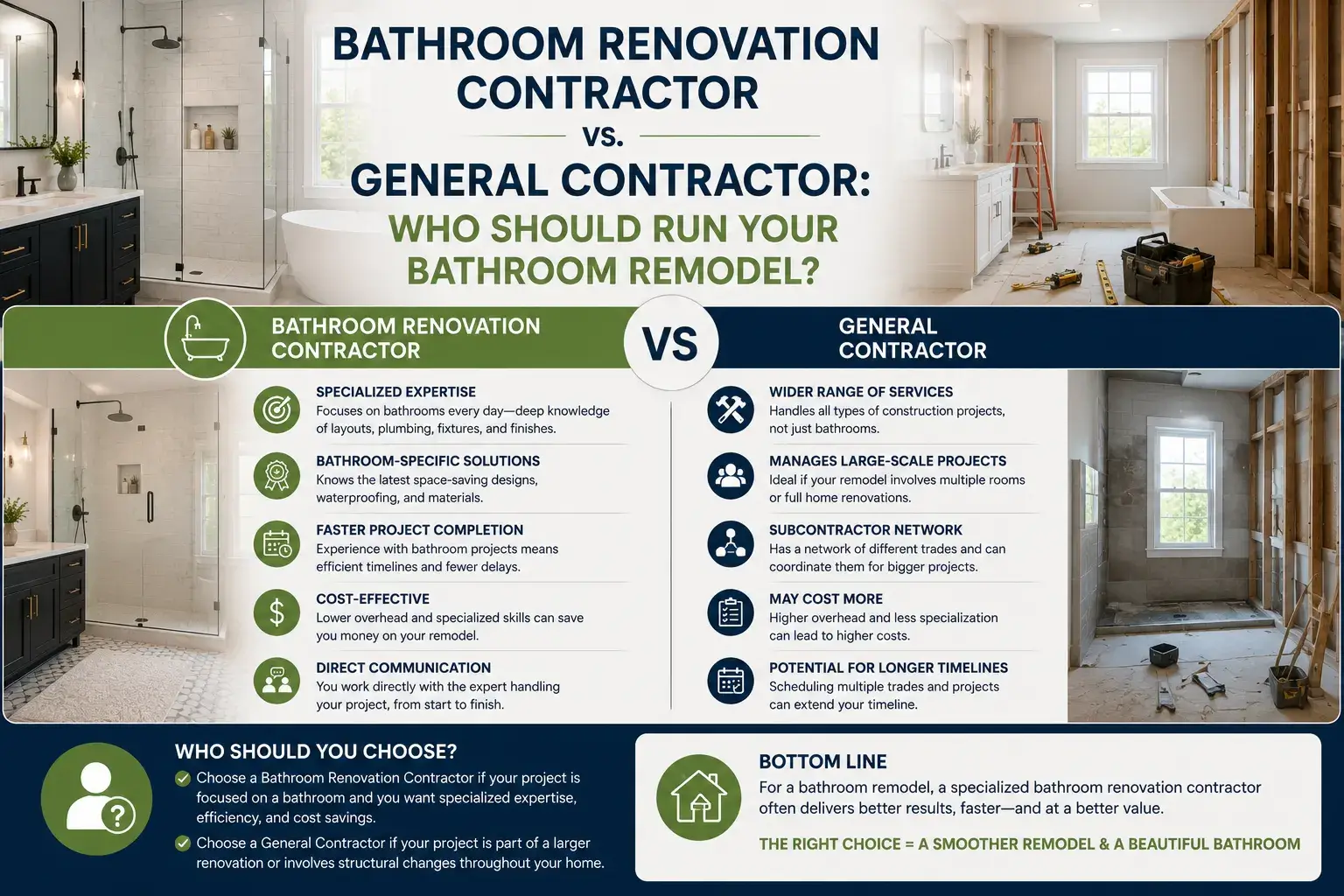
If you’ve started calling around for quotes, you’ve probably noticed that not every company you’re talking to does the same kind of work. Some are bathroom renovation contractors who focus specifically on bathrooms and maybe kitchens. Others are general contractors who’ll remodel your bathroom this month and build a deck next month. Both can do good work. But they approach a bathroom remodel differently, and that difference affects your budget, your timeline, and how the finished room actually holds up.
This breaks down what genuinely separates a bathroom renovation contractor from a general contractor, where each one tends to perform better, and how to decide which fits your specific project.
What a Bathroom Renovation Contractor Actually Specializes In
A bathroom renovation contractor works on bathrooms constantly, often dozens of them a year, sometimes exclusively. That repetition builds a specific kind of expertise: shower pan slope calculations that prevent standing water, waterproofing membrane application that actually holds up behind tile for decades, and tile layout planning that avoids awkward cuts around fixtures. These are details that become second nature through repetition in a way they simply can’t for a contractor who remodels one or two bathrooms per quarter.
Bathroom-focused contractors also tend to use the same core crew across projects rather than assembling different subcontractors for each job, which means the plumber, tile setter, and electrician have likely worked together before on similar bathroom layouts.
What a General Contractor Brings to a Bathroom Remodel
A general contractor is built for coordinating multiple trades and multiple types of work under one roof, kitchens, additions, decks, whole-home renovations, and bathrooms all fall within scope. That breadth is genuinely valuable when your bathroom remodel is part of a larger project involving more than one or two specialties, since a general contractor is already set up to sequence plumbing, electrical, framing, and finish work across several rooms at once.
The tradeoff is depth. A general contractor completing a handful of bathrooms a year as part of a broader project mix generally hasn’t repeated the specific technical details of bathroom waterproofing and tile work as often as a specialist has.
Side-by-Side Comparison
| Factor | Bathroom Renovation Contractor | General Contractor |
| Project focus | Bathrooms, often alongside kitchens | Wide range: additions, decks, kitchens, whole-home work |
| Bathroom-specific repetition | High; waterproofing and tile work done constantly | Lower; bathrooms are one project type among many |
| Subcontractor markup | Often uses an established in-house or long-term crew | May layer markup across multiple subcontracted trades |
| Best fit | A bathroom remodel as the primary or only scope | A bathroom remodel bundled with other rooms or systems |
| Typical timeline | Often shorter, since the same crew handles the full process | Can run longer due to coordinating trades across a broader project |
| Waterproofing depth | Frequently a core specialty | Varies by individual contractor’s experience |
Where Waterproofing Expertise Matters Most
Waterproofing is the single most consequential system in any bathroom, and it’s also the one that’s completely invisible once tile goes up. A waterproofing failure doesn’t just mean a leak; it can damage structural framing, subfloor, and even adjacent rooms or the floor below, sometimes for months before anyone notices a soft spot in the flooring or discoloration on a ceiling.
This is the area where the difference between a bathroom specialist and a general contractor shows up most clearly. A contractor who waterproofs showers weekly has a stronger instinct for slope, membrane overlap, and drain integration than one who handles it a few times a year. That doesn’t mean every general contractor gets this wrong, but it’s exactly the detail worth asking about directly, regardless of which type of contractor you’re considering.
Cost Differences Explained
Pricing differences between the two types of contractors usually come down to overhead structure rather than raw skill. General contractors often charge a markup on every subcontractor they bring in, on top of their own project management fee, since they’re typically coordinating separate specialists for plumbing, electrical, and tile. A bathroom-focused remodeling company that uses its own established crew for most of the work can often reduce or eliminate that layered markup.
For context, most Connecticut homeowners spend $16,000 to $28,000 on a mid-range full bathroom remodel, with luxury primary suites reaching $55,000 or more, according to our detailed bathroom remodel cost guide. Where a specific quote falls in that range depends more on scope, tile choice, and whether plumbing is being relocated than on which type of contractor you hire, but overhead structure is worth asking about directly when comparing quotes.
Timeline Differences Explained
A general contractor coordinating multiple trades across a bathroom remodel can take longer simply due to scheduling complexity, lining up a plumber, electrician, and tile setter separately, plus drying and curing time between steps. A specialist advertising a shorter installation window often has an advantage here, since their crew handles the same sequence of steps repeatedly and doesn’t need to coordinate around other active projects for separate subcontractors.
That said, timeline also depends heavily on scope. A cosmetic bathroom refresh typically takes one to two weeks regardless of who you hire, while a full gut renovation with a layout change runs three to five weeks or longer, as we cover in our bathroom remodel timeline guide. Ask any contractor, specialist or general, for a written schedule with a firm completion date rather than a vague range.
When a Bathroom Specialist Is the Better Choice
- Your project is limited to the bathroom itself, without major work in adjoining rooms.
- You want a curbless shower, custom tile work, or a layout change that depends heavily on precise waterproofing.
- You’ve had issues with soft flooring, past leaks, or moisture problems and want a contractor with deep, repeated experience solving exactly that.
- You’re prioritizing a shorter timeline for a single-room project.
When a General Contractor Makes More Sense
- Your bathroom remodel is happening alongside kitchen work, an addition, or a broader full home remodeling scope.
- You want one team managing your entire project scope rather than coordinating a bathroom specialist separately from other trades.
- Your renovation involves more than two specialties, structural, electrical, plumbing, and finish work all at once across multiple rooms.
Questions to Ask Either Type of Contractor
- How many bathroom remodels have you completed in the past year specifically?
- Who handles waterproofing, and is that person part of your core crew or a separate subcontractor?
- Is pricing fixed in writing, and what’s included versus what could become a change order?
- What’s your process for a curbless shower or layout change, if that’s part of your project?
- Are you Connecticut HIC-registered, bonded, and insured, and can I verify that independently?
- What’s the completion date in writing, and what happens if you run past it?
Best Practices Regardless of Who You Hire
- Ask to see photos or references from bathroom-specific projects in a project portfolio, not just general renovation work.
- Get a fixed-price, itemized quote before signing, covering demolition, waterproofing, tile, fixtures, and labor as separate line items.
- Confirm who is personally responsible for waterproofing and ask about their specific process.
- Build in a contingency fund of 10 to 15 percent, since older Connecticut homes often reveal issues like water damage or outdated plumbing once demolition starts.
- Request a written completion date and ask what recourse you have if the project runs long.
FAQs
Is a bathroom renovation contractor better than a general contractor?
Neither is automatically better. A bathroom-focused contractor typically brings deeper, more repeated expertise in waterproofing and tile work, while a general contractor is better suited to a bathroom remodel bundled with broader home renovation work.
Do general contractors charge more for a bathroom remodel?
Often yes, since general contractors frequently mark up subcontracted trades in addition to their own project management fee. A specialist using an established in-house crew can sometimes reduce that layered cost, though pricing varies by company.
How do I know if a contractor has real bathroom-specific experience?
Ask directly how many bathroom projects they’ve completed in the past year, request to see a portfolio of finished bathrooms, and ask who specifically handles waterproofing on their team.
What’s the biggest risk of hiring the wrong type of contractor for a bathroom remodel?
Waterproofing failure is the most serious risk, since it can damage framing, subfloor, and adjacent spaces long before it’s visible. This makes verified waterproofing experience one of the most important factors regardless of contractor type.
Should I hire a general contractor if I’m only remodeling my bathroom?
Not necessarily. If your project is limited to the bathroom itself, a specialist often offers a faster timeline and deeper technical expertise for that single scope.
Can a general contractor do a good job on a bathroom remodel?
Yes, many general contractors handle bathroom remodels well, particularly when the bathroom is part of a larger project. The key is confirming their specific bathroom experience and who handles waterproofing, rather than assuming broad renovation experience automatically covers it.
How much does a bathroom renovation contractor typically charge in Connecticut?
Most Connecticut homeowners spend $16,000 to $28,000 for a mid-range full bathroom remodel, with costs ranging from around $8,000 for a cosmetic refresh to $55,000 or more for a high-end primary suite.
Conclusion
The choice between a bathroom renovation contractor and a general contractor comes down to the shape of your project. A bathroom-focused specialist typically brings deeper waterproofing and tile expertise along with a tighter timeline for a single-room scope. A general contractor makes more sense when your bathroom remodel is one piece of a larger renovation involving multiple rooms or systems. Either way, verify licensing, ask specifically about waterproofing experience, and get a fixed-price quote in writing before you commit. CT Elite Remodel is a Connecticut-registered, bonded, and insured bathroom renovation contractor serving Orange, Milford, Hamden, North Haven, Wallingford, and New Haven County, with proper waterproofing and ventilation on every project and a fixed price backed by our $100-a-day, on-time guarantee. Get your free quote and find out what your bathroom remodel would actually involve.