
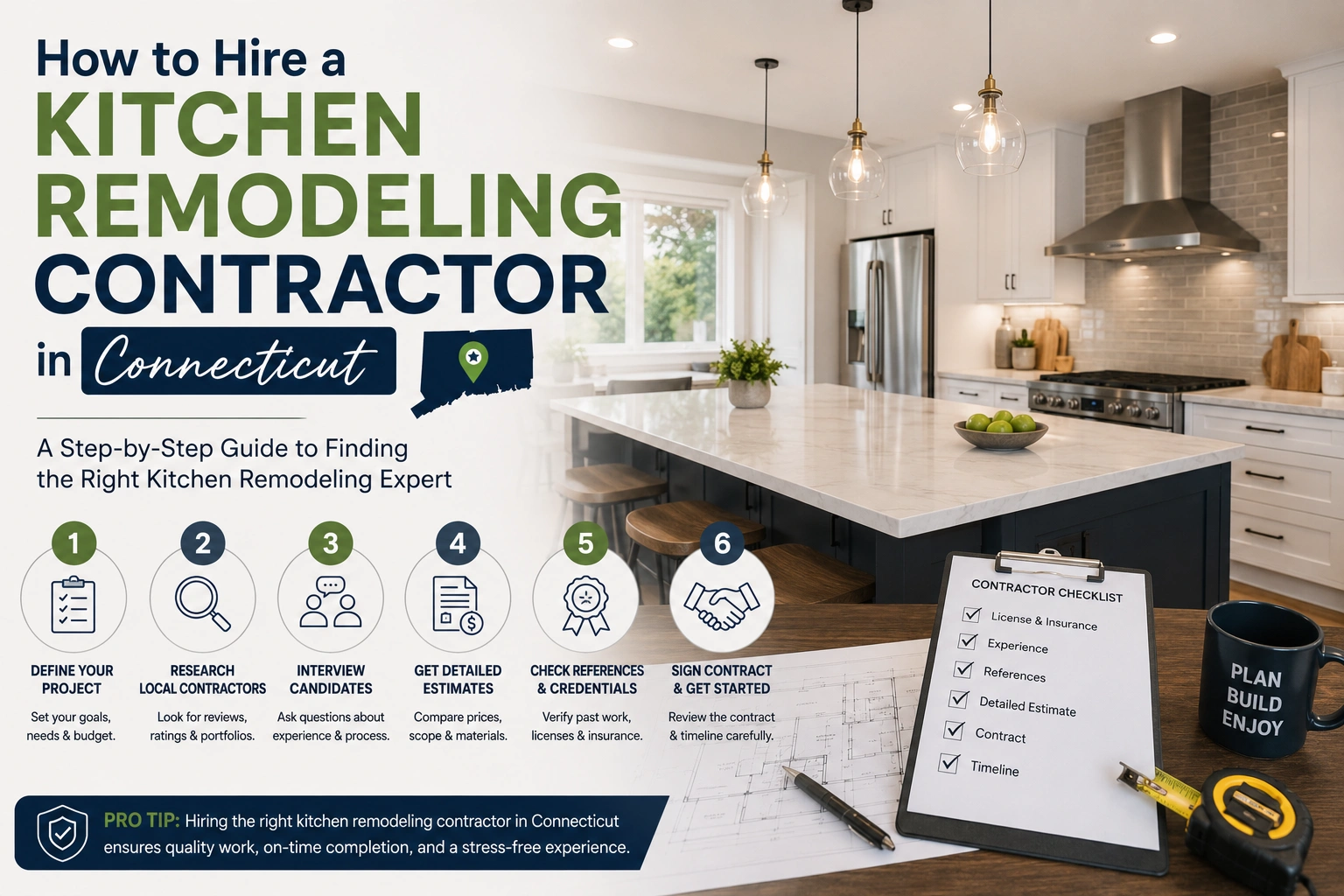
If you’re searching for a kitchen remodeling contractor, you’ve probably already heard a horror story or two: the crew that vanished mid-project, the quote that doubled once demo started, the “six-week job” that stretched into six months. None of that is inevitable. It happens when homeowners hire on price alone and skip the checks that separate a reliable kitchen remodel contractor from a risky one.
This is a real vetting checklist covering what licensing and bonding actually mean in Connecticut, what to ask past clients, and what a fixed-price quote should look like before you sign anything. By the end, you’ll know exactly what to check before hiring a kitchen remodeling contractor for your Connecticut home.
Why Vetting a Kitchen Remodeling Contractor Matters
A kitchen is the most expensive room in the house to get wrong, and the room your family can least afford to lose for months at a time. When homeowners skip the vetting step, the same three problems show up over and over: the price creeps upward after demolition starts, the timeline slides without a firm date attached, and communication goes quiet right when you need answers most.
None of those problems are about bad luck. They’re about what got confirmed, or didn’t, before the contract was signed. A contractor who is properly licensed, bonded, and willing to put pricing in writing has already solved most of what goes wrong on other people’s projects.
Step 1: Confirm Licensing and Registration
Connecticut regulates residential remodeling work through Home Improvement Contractor (HIC) registration, administered by the Department of Consumer Protection under Chapter 400 of the Connecticut General Statutes. Any contractor performing remodeling work over $200 on a single contract, or more than $1,000 in a 12-month period, is required to register.
Here’s what to actually check:
- Ask for the HIC registration number and look it up on the DCP’s eLicense portal yourself. Don’t take a business card’s word for it.
- Confirm the registration is current. HIC registrations renew annually by November 30, and a lapsed registration is a warning sign.
- Ask who will be on the job. A kitchen remodeling contractor should be able to name the licensed plumbers and electricians handling those trades, since plumbing and electrical work require their own state licensing beyond HIC registration.
A quick note on what HIC registration does and doesn’t guarantee: Connecticut’s HIC registration doesn’t require passing an exam or proving prior experience, and the state’s minimum liability insurance requirement is lower than what most homeowners assume. Unregistered contractors are also one of the more common sources of consumer complaints filed with the DCP each year, usually after a deposit was paid and the work never finished, so a five-minute lookup before you sign is worth the time. For a broader vetting list beyond licensing, our top 10 questions to ask before hiring a contractor is a useful companion to this checklist.
Step 2: Verify Bonding and Insurance
Bonding and insurance protect you financially if something goes wrong, whether that’s a worker injury on your property or a contractor who takes a deposit and disappears. This is a step where “we’re insured” isn’t a sufficient answer.
| What to Verify | Why It Matters | What to Ask For |
| General liability insurance | Covers property damage during the project | Certificate of insurance naming you as the project address |
| Workers’ compensation | Protects you if a worker is injured on-site | Proof of active workers’ comp coverage |
| Surety bond (if applicable) | Financial backstop if the contractor fails to complete work | Bond amount and issuing company |
| HIC registration status | Confirms the contractor is legally authorized to do the work | Registration number, verified independently |
Connecticut’s state minimum for liability insurance under HIC registration is notably low, so a contractor could technically meet state requirements while carrying far less protection than your project needs. Look for at least $1 million in liability coverage. At CT Elite Remodel, every project is backed by Connecticut HIC registration, a $15,000 bond, and $1 million in liability insurance, and we’ll show you the paperwork before you ask twice.
Step 3: Check References the Right Way
Most homeowners ask for references and stop there. The references that tell you something require a few more minutes on the phone.
Questions worth asking past clients:
- Did the final price match the original quote, or were there change orders that surprised you?
- Did the project finish on the date you were told, and if not, by how much did it slip?
- How did the contractor communicate during the project, and how quickly did they respond to problems?
- Would you hire this contractor again for a different room?
- Did the crew clean up daily, or did the mess pile up between visits?
Ask to see at least one project similar in scope to yours, whether that’s a full gut remodel or a cosmetic refresh. A contractor’s portfolio of finished kitchens tells you more about craftsmanship than any sales conversation will.
Step 4: Read the Fixed-Price Quote Line by Line
This is where most kitchen remodels either stay on budget or start sliding. A vague estimate with round numbers almost always turns into change orders once work begins. A real fixed-price quote should read like a contract, not a sales pitch.
What a Trustworthy Quote Includes
- Itemized costs by category. Cabinetry, countertops, flooring, plumbing, electrical, and labor should each appear as separate line items, not folded into one lump sum.
- A firm completion date, not a range like “8 to 12 weeks.” Ask what happens contractually if that date is missed.
- Named allowances for materials. If cabinetry has a $12,000 allowance, you should know that before you fall in love with a $20,000 line.
- A clear change-order process. Nothing should change the total price without your written sign-off first.
- Payment schedule tied to milestones, not a large deposit upfront with vague payment triggers after that.
If a quote is missing any of these, ask for it in writing before signing. Our kitchen remodel cost breakdown is a useful starting point for understanding what typical Connecticut pricing looks like before you compare quotes side by side.
General Contractor vs. Kitchen Specialist
Not every remodeling company approaches a kitchen the same way. Understanding the difference helps you ask better questions during your consultations.
| Factor | General Contractor | Kitchen-Focused Remodeler |
| Project mix | Kitchens, additions, decks, whole-home work | Concentrated kitchen and related remodeling experience |
| Subcontractor markup | Often layers a markup on every trade brought in | Frequently uses an established in-house or long-term trade team |
| Familiarity with cabinetry lead times | Varies by project volume | Typically has direct supplier relationships |
| Best fit for | Projects spanning multiple rooms or systems | A kitchen remodel as the primary scope |
Neither structure is automatically better. What matters is whether the company can show real kitchen project history, name their trade partners, and back their pricing in writing. If your project also includes a bathroom remodel or spans more than one room, ask specifically how they coordinate trades across a larger full home remodeling scope.
Red Flags to Walk Away From
- A quote that’s significantly lower than every other bid with no clear explanation why.
- Reluctance to provide a written contract before starting work.
- No fixed completion date, or vague language around delays.
- Requests for a large cash deposit before any contract is signed.
- No verifiable HIC registration number.
- Pressure to sign the same day, with “today only” pricing.
Questions to Ask Before You Sign
- Are you registered with the Connecticut DCP, and can I verify that number myself?
- What’s your general liability coverage, and can I get a certificate of insurance?
- Who handles plumbing and electrical, and are they separately licensed?
- What’s the payment schedule, and what triggers each payment?
- What happens if the project runs past the completion date in the contract?
Best Practices Once You’ve Hired Your Contractor
- Get every change, no matter how small, in writing before it happens.
- Ask for a point of contact you can reach directly instead of chasing subcontractors.
- Walk the space with your contractor before final payment and confirm every line item from the quote was completed.
FAQs
How do I verify a contractor’s HIC registration in Connecticut?
Search the contractor’s name or registration number on the Connecticut Department of Consumer Protection’s eLicense lookup tool. This confirms whether the registration is active and in good standing.
Should I get multiple quotes before hiring a kitchen remodel contractor?
Yes. Getting at least three detailed quotes lets you compare not just price, but what’s actually included, which is often where the real differences show up.
How long does a kitchen remodel typically take in Connecticut?
Most kitchen renovations run 6 to 12 weeks from demolition to final walkthrough, though custom cabinetry and layout changes can extend that timeline. Our guide on kitchen renovation costs covers the factors that affect both budget and schedule.
What’s the difference between a licensed contractor and an HIC-registered contractor?
HIC registration authorizes a company to perform home improvement work in Connecticut. Plumbers and electricians need their own separate state trade licenses, which a reputable contractor will confirm are current.
Can a contractor start work before permits are approved?
No. Permits for plumbing, electrical, and structural changes should be approved first. Starting without permits can create problems later, including issues when you sell the home.
Is the lowest quote usually the best choice?
Not necessarily. A significantly lower bid often means something is missing, whether that’s permit fees, disposal costs, or lower-grade materials.
Conclusion
Hiring the right kitchen remodel contractor comes down to a handful of checks that take less time than picking out a backsplash: confirm licensing, verify bonding and insurance, call references with real questions, and read the fixed-price quote line by line before signing anything. Skip those steps and you’re gambling on a project that touches plumbing, electrical, and the room your family uses every single day.
CT Elite Remodel is a Connecticut-registered, bonded, and $1 million-insured kitchen remodeling contractor serving Orange, Milford, Hamden, North Haven, Wallingford, and the greater New Haven County area. Every project starts with a free in-home consultation and a fixed-price quote in writing, backed by a $100-a-day guarantee if we run past the completion date we agree on. Get your free quote and see what a kitchen remodel contractor with nothing to hide looks like.